

Conference Room AV Integration Service and the Mess Meetings Inherent Without It
How everyday AV failures quietly derail important conversations?
Most meetings do not fail outright. They lose effectiveness through small, repeated technical issues. Voices are not heard clearly across the room, leaving some participants engaged while others struggle to follow the discussion. Screens take time to connect, and shared content is often difficult to see once it appears. In hybrid meetings, remote participants struggle to follow visual references that are easily visible to those in the room. The meeting continues, but time is spent correcting issues instead of advancing decisions, and discussion slows as participants adjust to the limitations of the space.
These issues place people in uncomfortable positions. Teams pause discussions to fix connections. Leaders grow impatient. Someone is held responsible for problems that have nothing to do with preparation or competence. The pressure is real, even if the cause is not always acknowledged. When audio, video, cameras, and displays operate as disconnected pieces, meetings become unpredictable, and credibility suffers.
This is the gap a conference room AV integration service addresses. Without integration, meetings depend on workarounds and tolerance. With expectations rising around hybrid collaboration, that tolerance is shrinking. What should be a straightforward exchange turns into an exercise in managing limitations rather than advancing decisions.
SRSG’s Conference Room AV Integration Service That Restores Control to Meetings
How integrated AV systems bring consistency back into everyday collaboration
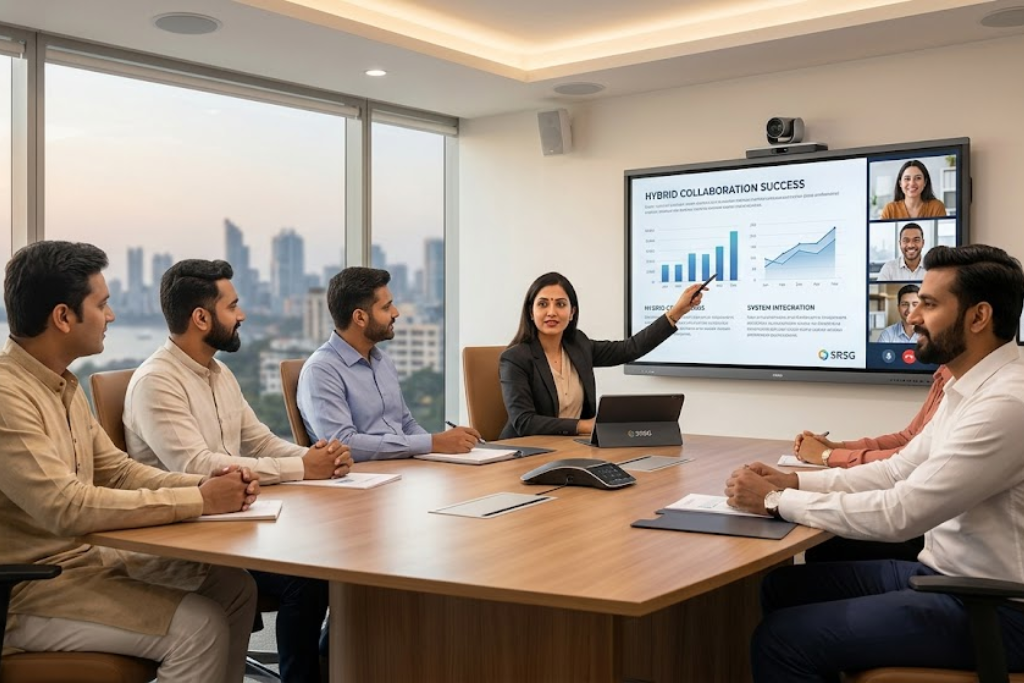
Solving these issues requires more than replacing individual devices. It requires designing the conference room as a single, coordinated system.SRSG’s conference room AV integration service integrates audio, video, displays, and AV control into a single, reliable meeting system. Installed room audio systems ensure voices are captured evenly across the table, reducing misunderstandings and the need to repeat information.
Visual communication is supported through commercial displays, interactive panels, and projection solutions that make shared content clear and readable for everyone in the room. For hybrid meetings, integrated video conferencing setups combine cameras, microphones, and speakers into unified systems, allowing remote participants to follow discussions without interruption. These elements are supported by AV switching, signal management, and room control solutions that simplify connections and reduce setup time. When audio, visuals, and conferencing tools work as a single system, meetings run more smoothly, and teams can focus on the discussion instead of handling technical issues.
Why Organisations Rely on SRSG for Conference Room AV Integration Services
Because integration only works when someone owns the outcome
A conference room AV integration service involves more than installing equipment and walking away. What determines success is how the room is planned, how systems are brought together, and how they are supported once the room is in use. SRSG takes responsibility for conference room integration from design through deployment and ongoing support.
This approach ensures AV systems work smoothly within existing environments, without the need for constant tweaks or fixes. Decisions are made early, coordination happens before installation, and rooms are tested for real use rather than ideal conditions. As a result, conference rooms do not depend on specific individuals to keep them running. For decision-makers, this matters. It reduces follow-up issues, avoids repeated fixes, and ensures conference rooms continue to function as usage grows and expectations change. That level of ownership is what defines a dependable conference room AV integration service.